

What is Gravure Printing Machine?
Gravure printing is a widely used processing method often used to print large volumes of magazines and catalogues. Opposed to flexoprinting, the ink in gravure printing is transferred from carved micro cavities and not from a relief. These cavities, embedded in the printing cylinder, form the printing pattern.
Why Choose Us
High Quality
Our products are manufactured or executed to very high standards, using the finest materials and manufacturing processes.
Advanced Equipment
Our company has obtained QMS, OHSAS, EMS, CE and other management system certifications, and has obtained a number of invention patents and utility model patents such as printing machines and copperplate machines.
24H Online Service
We try and respond to all concerns within 24 hours and our teams are always at your disposal in case of any emergencies.
One-stop Solution
Company in line with the quality first customer first people-oriented purpose, can provide users with all kinds of pre-sales technical consultation, installation and debugging and technical training, to ensure that customer problems can be timely and satisfactory solution.
-

Tipping Paper Shaftless Driven Gravure Printing Machine
Shaftless-driven (Electronic Shaft) | Auto-register | High Speed | 600-1000mm. Applications: cigarette tipping paper, inner liner, soft pack, softpack label, etc.
Add to Inquiry -
Tipping Paper Electronic Shaft Gravure Printing Machine
Shaft-driven | Auto-register | High Speed | 800-1000mm. Applications: cigarette tipping paper, inner liner, soft pack, softpack label, rolling paper, etc.
Add to Inquiry -
Tipping Paper High Speed Gravure Printing Machine
Shaft-driven | Auto-register | 600mm. Applications: cigarette tipping paper, inner liner, soft pack, softpack label, rolling paper and other thin paper.
Add to Inquiry -
Tipping Paper Shaft Driven Gravure Printing Machine
Shaft-driven | Auto-register | 600mm. Applications: cigarette tipping paper, inner liner, soft pack, softpack label, rolling paper and other thin paper.
Add to Inquiry


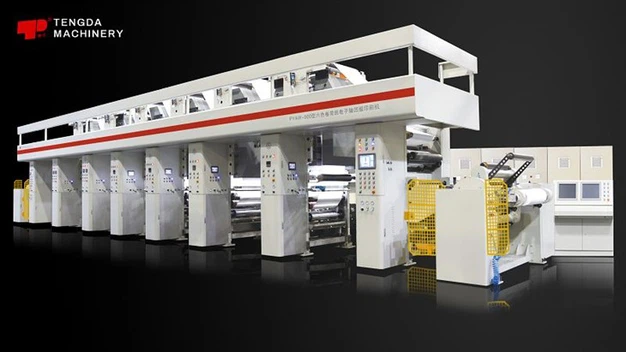
● Gravure printing is the only high speed and volume print process capable of printing continuous tone images.
● As a direct print process gravure printing results in better ink laydown and more consistent print quality.
● Printing times are extremely quick, with modern presses able to produce up to 14m of film per second.
● Gravure printing uses quick drying solvent based inks to help speed up the print process.
Process Description Gravure Printing Machine
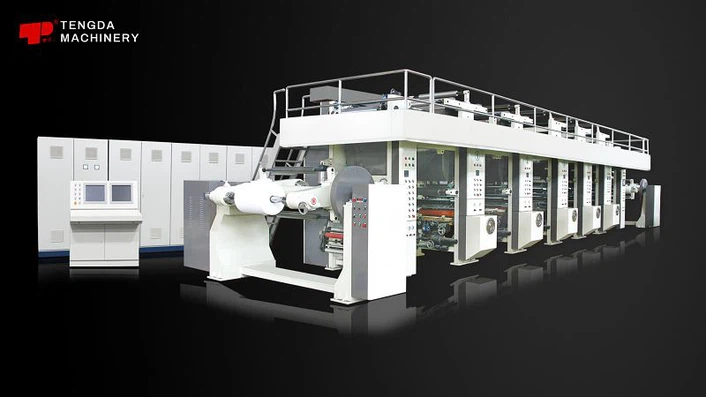
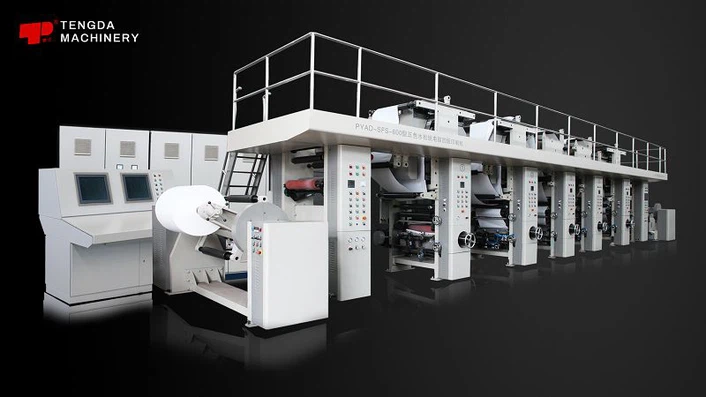
During the gravure printing process the printing cylinder rotates in the ink pan where the engraved cells fill with ink. As the cylinder rotates clear of the ink pan, any excess ink is removed by the doctor blade. Further around, the cylinder is brought into contact with the substrate, which is pressed against it by the rubber covered impression roller.
Process Description Gravure Printing Machine
The pressure of the roller, along with the capillary draw of the substrate, results in the direct transfer of ink from the cells in the printing cylinder to the surface of the substrate. As the printing roller rotates back into the ink pan, the printed area of the substrate proceeds through a dryer and onto the next printing unit, which is normally a different color or may be a varnish or coating.
Process Advantages and Applications
The process offers the ability to transfer ink consistently, across a wide range of densities, and at high speeds, making it suitable for applications which require high image quality, such as publishing, packaging, labels, security print, and decorative printing.
01
The durable nature of the printing cylinders used makes gravure printing an ideal process for providing high quality print on very long or regularly repeating runs, delivering cost advantages over other processes.maintained.
02
As the process is almost entirely automated the labour costs are relatively low
03
Gravure cylinders are extremely durable, can be used for several print runs, as long as they are used regularly and can be

● When operating, do not put your hand into the running part of the machine, especially the clamping roller.
● When checking the machine, the main power switch on the main control cabinet must be turned off.
● When the machine is stopped for operation adjustment, the stop button should be locked.
● Turn off the main power supply when doing electrical inspection.
● When threading and cleaning the hot roller in the drying oven, be sure to turn off the heat source first.
● Before starting the machine, it should be confirmed that the exhaust air of the drying oven and the ventilation of the workshop are normal.
Gravure printing products have the advantages of thick ink layer, rich layer, strong three-dimensional sense and good printing quality, and are mainly used for printing exquisite color pictures, trademarks, decorations, securities and color newspapers. Due to the complex plate-making process, long cycle and environmental pollution of benzene-containing ink, gravure printing machine has not been widely used in China. Therefore, measures such as improving the plate-making process, shortening the plate-making time, using non-polluting ink, reducing energy consumption, and reducing costs are being studied and improved.
The main feature of the gravure printing press is that the graphic part on the printing plate is concave and the blank part is convex, which is just the opposite of the layout structure of the letterpress printing machine. When the machine prints monochrome, the printing plate is first immersed in the ink tank and rolled, and the entire printing plate surface is coated with an ink layer. Then, the ink layer on the surface of the printing plate that belongs to the blank part is scraped off, the raised part forms a blank, and the recessed part is filled with ink, and the deeper the recess, the thicker the ink layer. The machine transfers the ink from the recessed part to the printed matter by applying pressure, so as to obtain the printed matter.
When printing multi-color, the overprint method or indirect local inking method is adopted, so that the ink of various colors is distributed in the relevant part of the printing plate surface according to the need, and the basic printing principle of printing multi-color is the same as printing monochrome. There are two main types of printing plates used in gravure printing machines, one is photogravure, that is, photocopying plates; The other is an engraving version. There are methods of engraving for engraving plates, such as hand engraving, mechanical engraving and electronic engraving.

● For the feeding part, the sheet-fed gravure press is a paper stack type sheet-fed continuous feeding, and the web gravure press is continuously fed with web paper.
● In the printing part, there are three kinds of arrangement of the printing plate cylinder and the embossing cylinder: vertical, horizontal and oblique, and the printing plate cylinder is arranged below. Generally, each unit has 1 printing plate cylinder and 1 embossing cylinder. In order to increase the printing pressure, some are equipped with two impression cylinders.
●The ink feeding device has the direct ink feeding of the printing plate cylinder partially immersed in the ink groove and the indirect ink feeding of the ink to the printing plate cylinder by the ink roller immersed in the ink tank, and the inkjet method is also used in the high-speed machine.
● The drying part is hot air heated by electricity or steam, and some use infrared or far-infrared lamps to dry the printed matter.
● In the receiving part, the single sheet paper is piled up into a paper pile, and the web paper is cut and folded to collect or re-roll the paper roll. There are two types of structures: organic type and satellite type. The former is to set up the unit according to the required number of colors, each unit has 1 printing plate cylinder and 1~2 embossing cylinders, and the delivery part adopts the rewinding method.
Gravure printing can be known from its name: its text images are recessed into the layout. That is to say, the blank parts of the gravure plate are all on the same plane (layout), while the picture and text parts are located under the blank part, and are recessed into the layout at different depths to express the richness of the original image. Such printing plates are called gravure plates. Printing that reproduces images using gravure plates is called gravure printing. The dark tones on the original manuscript will have a greater concave depth in the corresponding printed part of the gravure plate; conversely, the brightest levels in the original manuscript will have a shallower concave depth in the corresponding printed part of the gravure plate. Therefore, the printing part of the gravure plate expresses the depth of the printed image according to the different inks contained in the depth of the indentation.
Classification of Gravure Printing
Engraving intaglio
Engraving gravure is to use a carving knife to directly carve pits corresponding to the original graphics and text on the surface of the printing plate cylinder. According to the control method of the carving knife, it can be divided into manual carving gravure, mechanical carving gravure and electronic carving gravure.
Hand-engraved intaglio
Hand-engraved gravure is made by technicians using a carving knife to manually engrave the surface of the printing plate cylinder according to the original graphics and text. The printing plate material can be copper plate or steel plate. The manual labor is heavy, the plate making cost is high, and the cycle is long. However, the hand-carved gravure has clear lines and a strong sense of layering, making it difficult to forge. Mostly used to produce printing gravure plates for securities and high-quality artworks.
Mechanical engraving gravure
Mechanical engraving gravure is made by using a mechanically controlled engraving knife to carve on the surface of the printing plate cylinder. It reduces the heavy labor of manual engraving, has fast plate making speed, shorter cycle, and lower plate making costs. It is mainly used to produce printing gravure plates for securities. Due to the high cost of manual and mechanical engraving plate making and the long plate making cycle, the scope of use is limited. But everything is divided into two. As far as anti-counterfeiting packaging is concerned, hand-engraved gravure may be the best plate-making method. Because secret anti-counterfeiting is a major method of anti-counterfeiting packaging, technicians can use various methods to carve some secret marks during the process of hand-engraved gravure. These secret marks on the hand-engraved gravure are not easy to be found, and are even more difficult to distinguish on printed matter. , which forms the secret to anti-counterfeiting.
Electronic engraving gravure
This kind of plate is engraved on the surface of the printing plate cylinder by an electronic control device controlling the engraving knife. An electronic engraving machine is used to control the engraving knife according to the photoelectric principle to carve out cells on the surface of the drum, and its area and depth change at the same time.
What Safety Issues Should We Pay Attention to When Using the Gravure Printing Machine
● Operators should receive professional training and be familiar with the operating procedures and safety precautions of the gravure printing machine.
● The gravure printing machine should be installed in a dry, well-ventilated place without direct sunlight, and avoid environments with moisture, high temperature, low temperature and dust.
● During operation, ensure that the channels around the equipment are clear so that accidents can be dealt with promptly when an accident occurs.
● Operators should wear protective equipment, such as protective gloves, protective glasses, etc., to prevent mechanical and chemical injuries.
● When the gravure printing machine is running, you should pay attention to the status and sound of the equipment. If any abnormality is found, stop it for inspection in time.
● During the printing process, printing materials should be prevented from getting stuck between the rollers of the gravure printing machine to avoid equipment damage and personal casualties.
● The gravure printing machine should be cleaned in time after use, and should be maintained and inspected regularly to ensure the normal operation and service life of the equipment.
● During the use of the gravure printing machine, relevant safety operating procedures and precautions should be followed to ensure the safety of operators and the normal operation of the equipment.
Gravure printing machine is a kind of equipment commonly used in printing, packaging, advertising and other fields.
Here’s how it works:
Printing plate preparation: First, make the pattern or text to be printed into a convex and concave plate.Intaglio. Intaglio plates are usually made of metal or rubber materials, with the concave side being the printing picture of.
Ink tray and ink knife: There is an ink tray on the gravure printing machine, which contains an appropriate amount of ink.Brush ink. There is an ink knife on the ink plate, which is used to scrape off excess ink to make the gravure Leave an appropriate amount of ink on the pattern part.
Roll paper: There is also a paper feed device on the printing press, in which the roll paper is transported to printing position.
Printing process: When the web enters the printing position, the ink on the ink tray is After scraping, only the pattern part on the gravure plate retains an appropriate amount of ink. Then, the paper is
The gravure contacts and applies enough pressure to transfer the ink. During the printing process, paper Continuous transfer, the gravure plate is in contact with the entire paper surface, allowing the pattern to be gradually transferred to the paper superior.
Drying and peeling: After printing, the printed paper is dried through the drying system. Allow the ink to cure. Finally, the printing paper is peeled off from the printing press to complete the entire printing
process.
What Are the Key Points in the Maintenance and Repair of Gravure Printing Machines?
As an efficient and high-precision printing equipment, the gravure printing machine requires regular maintenance and repairs during use to ensure its normal operation and extend its service life. The following are the key points for maintenance and repair of gravure printing machines:
Cleaning and Lubrication
The gravure printing machine should be cleaned regularly to remove dust and debris on the surface of the equipment to avoid wear and blockage of the equipment.
The rolling bearings, chains and gears of the gravure printing machine need to be lubricated regularly to reduce friction and wear.
Use appropriate lubricating oil or grease and ensure that the oil or grease does not contain impurities and particles.
Check and Adjust
Regularly check all parts of the gravure printing machine, including the gravure plate, impression cylinder, adjustment mechanism, etc., to ensure that they are in good condition.
Check the electrical system, pneumatic system, etc. of the equipment to ensure their normal operation.
Regularly adjust the pressure, speed, temperature and other parameters of the equipment to ensure printing quality and normal operation of the equipment.
Printing press parts maintenance
The gravure plate of the gravure printing machine is one of the key components and needs to be inspected and replaced regularly. If the gravure plate is severely worn or scratched, it should be replaced in time.
The impression roller is another critical component that requires regular cleaning and inspection to ensure its surface is smooth and free of damage.
Other wearing parts such as scrapers, ink tanks, etc. also need to be inspected and replaced regularly.
Gravure fixing and scratching issues
When installing the gravure plate, make sure it is firmly fixed to avoid loosening or shifting during the printing process.
If scratching occurs, it may be due to uneven surface of the gravure plate or improper angle and pressure of the squeegee. The angle and pressure of the scraper should be adjusted, or the scraper should be replaced with a new one.
If ink stains appear on the gravure plate, it may be caused by too much ink or an unclean squeegee. The ink level should be adjusted or the squeegee should be cleaned.
Preventive Maintenance
Regular preventive maintenance and upkeep can ensure the performance and extend the service life of your gravure printing press. For example: check the electrical system of the equipment to ensure that the wires are well connected and not loose; check the pneumatic system to ensure that the air path is smooth and leak-free; thoroughly clean and lubricate the equipment, etc.
Troubleshooting and troubleshooting
When a gravure printing machine fails, it should be stopped in time and inspected. According to the fault phenomenon and troubleshooting results, determine the cause of the fault and perform repairs. Common faults include electrical system faults, mechanical system faults, control system faults, etc. Solutions include replacing damaged parts, adjusting relevant parameters, repairing circuits, etc.
Safety Precautions
When repairing and maintaining gravure printing machines, safety operating procedures should be followed to ensure the safety of operators. For example: when disassembling and installing components, appropriate tools and methods should be used to avoid mechanical damage; when inspecting and repairing electrical systems, attention should be paid to the switching status of the power supply to avoid the risk of electric shock; when handling chemicals, protective clothing should be worn Protective equipment such as glasses and gloves to avoid chemical injuries.
Professional assistance
For some complex faults or problems that cannot be solved, it is recommended to seek professional assistance. They have extensive repair experience and professional skills and can provide more accurate diagnosis and solutions. At the same time, working with professionals can ensure the quality of repairs and the restoration of equipment performance.
Data compilation and recording
It is very important to establish complete equipment repair records and maintenance records. This helps track equipment maintenance history, summarize lessons learned, and improve equipment reliability. Records should include information such as maintenance time, fault symptoms, causes of faults, solutions, replacement parts, etc. In addition, it is recommended to save relevant technical information and manuals for easy reference and use.
Technical upgrades and updates
With the development and advancement of technology, gravure printing machines are constantly being updated. In order to maintain the competitiveness and production efficiency of equipment, it is recommended to regularly pay attention to the latest developments and technological progress of equipment manufacturers. If necessary, promptly carry out technical upgrades or replace new equipment.
Equipment maintenance system established
Establishing a complete equipment maintenance system is the key to ensuring the normal operation of the gravure printing press. The system should clarify the maintenance cycle, maintenance content, maintenance procedures, responsible personnel, etc. of the equipment, and require operators and managers to strictly implement it. At the same time, the implementation of the system should be regularly inspected and evaluated, and adjustments and improvements should be made based on the actual situation.
Emergency plan formulation
In order to deal with sudden failures or other emergencies, it is recommended to formulate an emergency plan. The emergency plan should include emergency handling procedures, backup equipment, contact persons and contact information, etc. By developing contingency plans in advance, emergencies can be responded to more quickly, reducing downtime and production losses.
Environmental protection and waste disposal
During the use and maintenance of gravure printing machines, some waste and hazardous substances may be generated. In order to protect the environment, these wastes and hazardous substances should be disposed of in accordance with relevant laws and regulations. For example: harmful substances such as waste oil and waste ink should be handed over to professional institutions for harmless treatment; discarded parts and materials should be stored in categories and recycled as much as possible. At the same time, it is recommended to use environmentally friendly printing materials and cleaning agents to reduce the negative impact on the environment.
Our Factory
Our company is a professional manufacturer of printing and packaging machinery and equipment. As a major manufacturer of tobacco packaging materials and equipment in China, it is also a major manufacturer of water pine paper equipment in the world. We have electronic shaft gravure printing machine, electronic shaft bronzing machine, high-speed double-shaft slitting machine, high-speed rewinding machine, laser punching machine, electrostatic punching machine series; Aluminum foil lining paper compound embossing stripping slitting machine


FAQ
Q: What are some fun facts about gravure printing?
Q: What is gravure printing most commonly used for?
Q: Why is gravure printing important?
Q: What are the advantages of gravure printing?
Q: What is the main difference between gravure and flexo printing?
Q: What is the difference between gravure and lithography?
Q: What is another name for gravure printing?
Q: What is the difference between digital printing and gravure printing?
Q: What materials are used in gravure printing?
Q: What is the difference between offset and gravure printing?
Q: Is gravure ink water based?
Q: What causes missing dots in gravure printing?
Q: How fast is gravure printing?
Q: What are the principles of gravure printing?
Q: How do gravure inks dry?
Q: What substrate for gravure printing?
Packaging printing: Cardboard, plastic film, aluminum foil, laminates, vinyl, non-porous materials.
Q: What are the limitations of gravure printing?
Q: What is the process of photo gravure printing?
Q: What is the solvent for gravure printing?
Q: What ink is used in gravure printing?
As one of the leading gravure printing machine manufacturers and suppliers in China, we warmly welcome you to buy durable gravure printing machine made in China here from our factory. Contact us for more details.
